
 Image 1 of 2
 Image 2 of 2
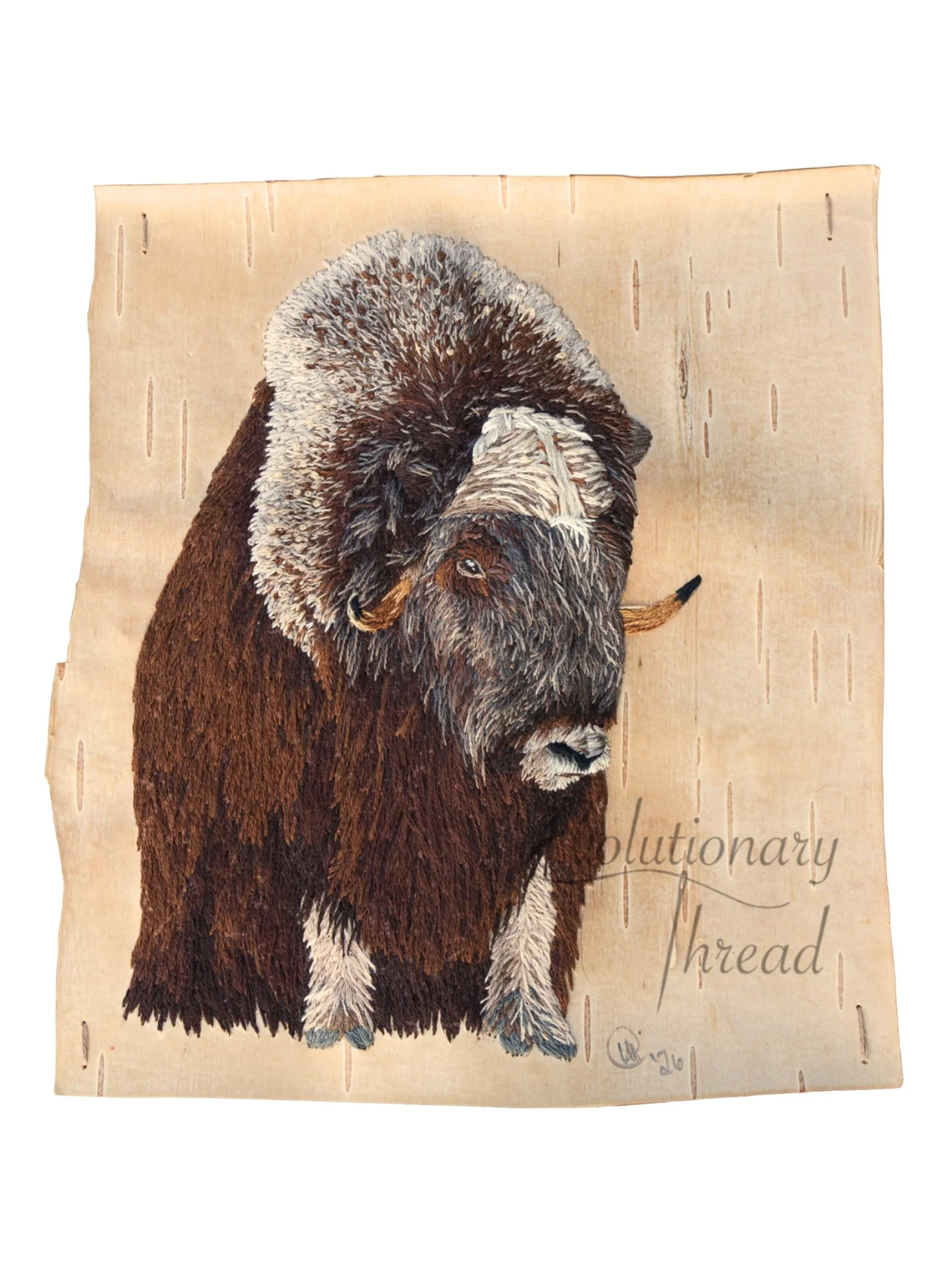
Muskoxen have historically lived primarily throughout Greenland, the Canadian arctic, and Eurasia.P opulations in Alaska, the Yukon Territory, and Siberia are all reintroduced along with a small population that was introduced to Norway (part of which has emigrated to Sweden. In the wild, they live in herds of 12-24 in the winter and 8-20 in summer when less dominant males are evicted from their winter herds.
In Woods Cree, the original language spoken in present day Manitoba's, Saskatchewan, and Alberta, the name "mâthi-môs" literally translates to "ugly moose". Despite this, I find them quite charming! In some places, these animals are partly domesticated in order to collect their incredibly soft and warm wool, called "qiviut". Along with their extremely well insulating fur, these animals are also heterothermic - they can shut off "heat" to some parts of their body to help reduce heat loss from their extremities! They have hemoglobin that is three times less temperature sensitive than humans, meaning they are much better equipped to hold oxygen in their blood at low temperatures.
Muskoxen have historically lived primarily throughout Greenland, the Canadian arctic, and Eurasia.P opulations in Alaska, the Yukon Territory, and Siberia are all reintroduced along with a small population that was introduced to Norway (part of which has emigrated to Sweden. In the wild, they live in herds of 12-24 in the winter and 8-20 in summer when less dominant males are evicted from their winter herds.
In Woods Cree, the original language spoken in present day Manitoba's, Saskatchewan, and Alberta, the name "mâthi-môs" literally translates to "ugly moose". Despite this, I find them quite charming! In some places, these animals are partly domesticated in order to collect their incredibly soft and warm wool, called "qiviut". Along with their extremely well insulating fur, these animals are also heterothermic - they can shut off "heat" to some parts of their body to help reduce heat loss from their extremities! They have hemoglobin that is three times less temperature sensitive than humans, meaning they are much better equipped to hold oxygen in their blood at low temperatures.